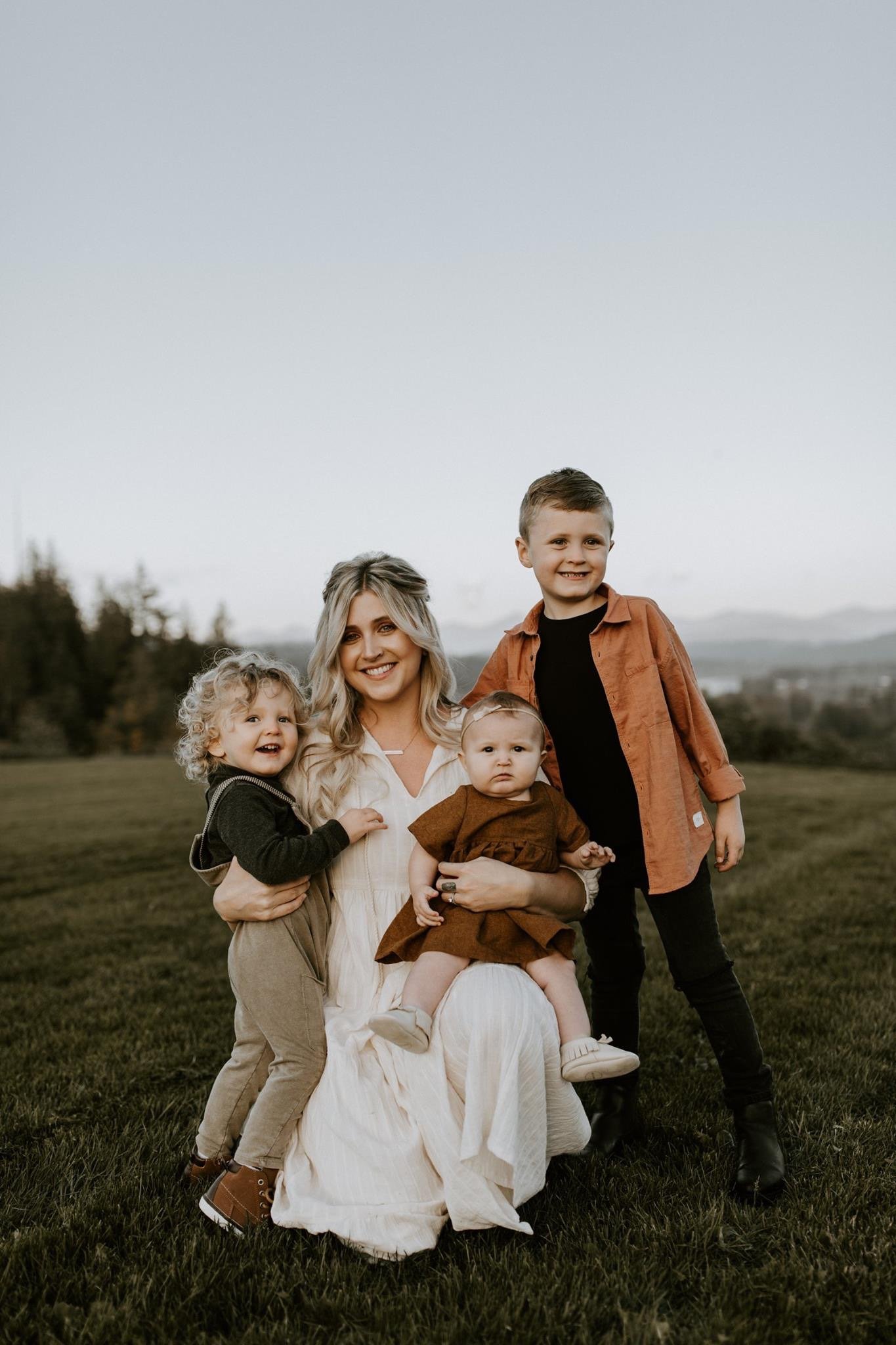
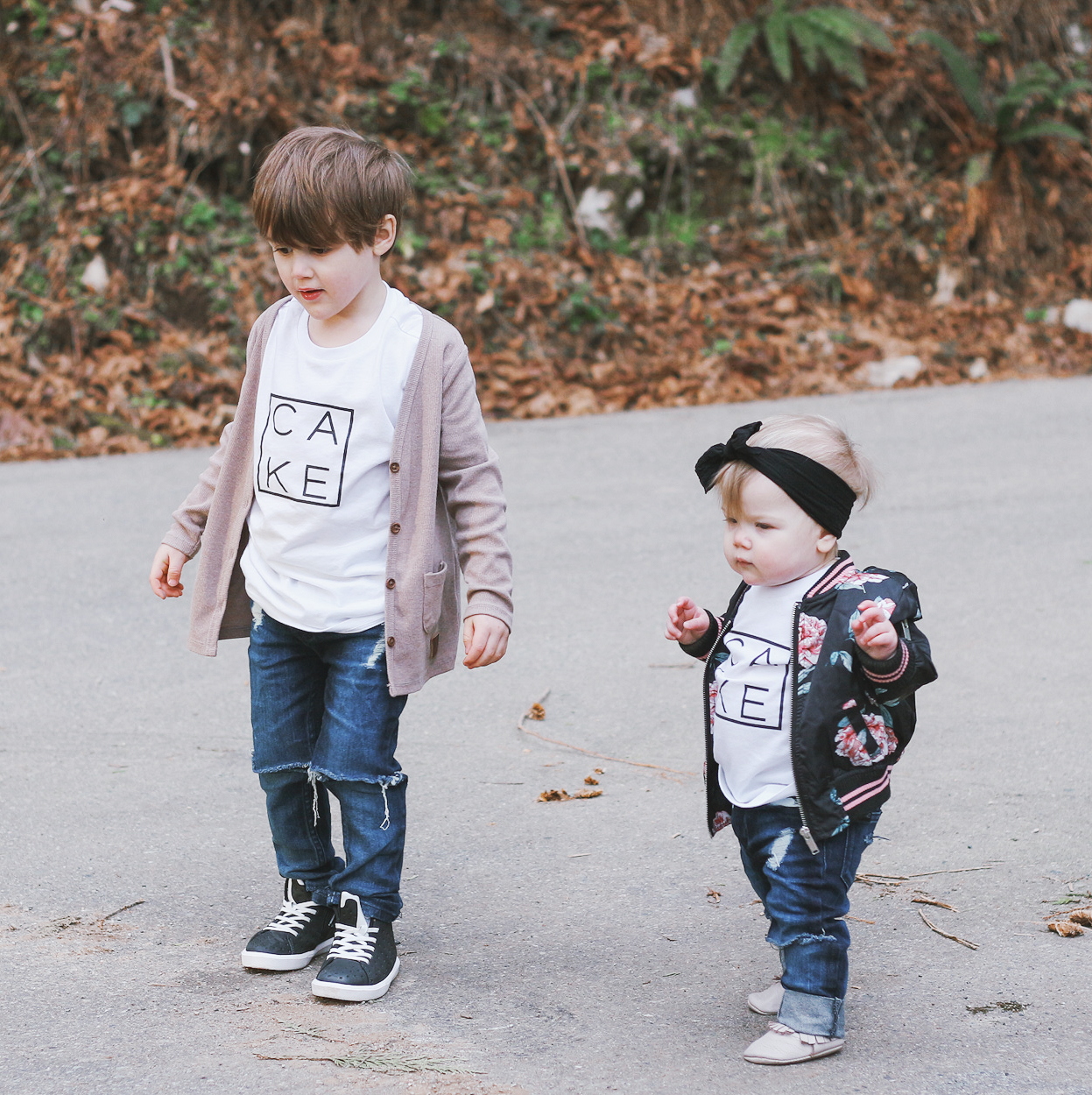
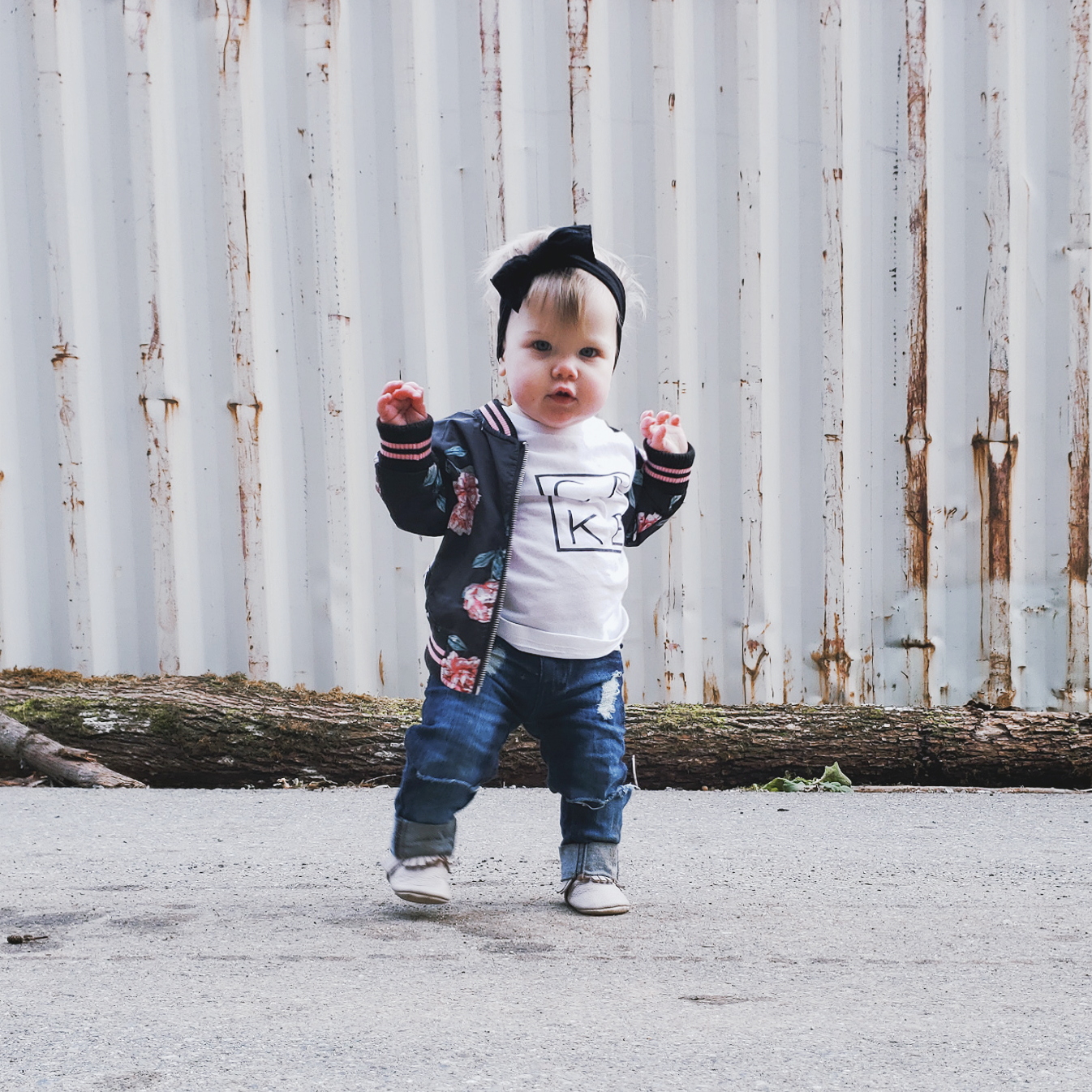
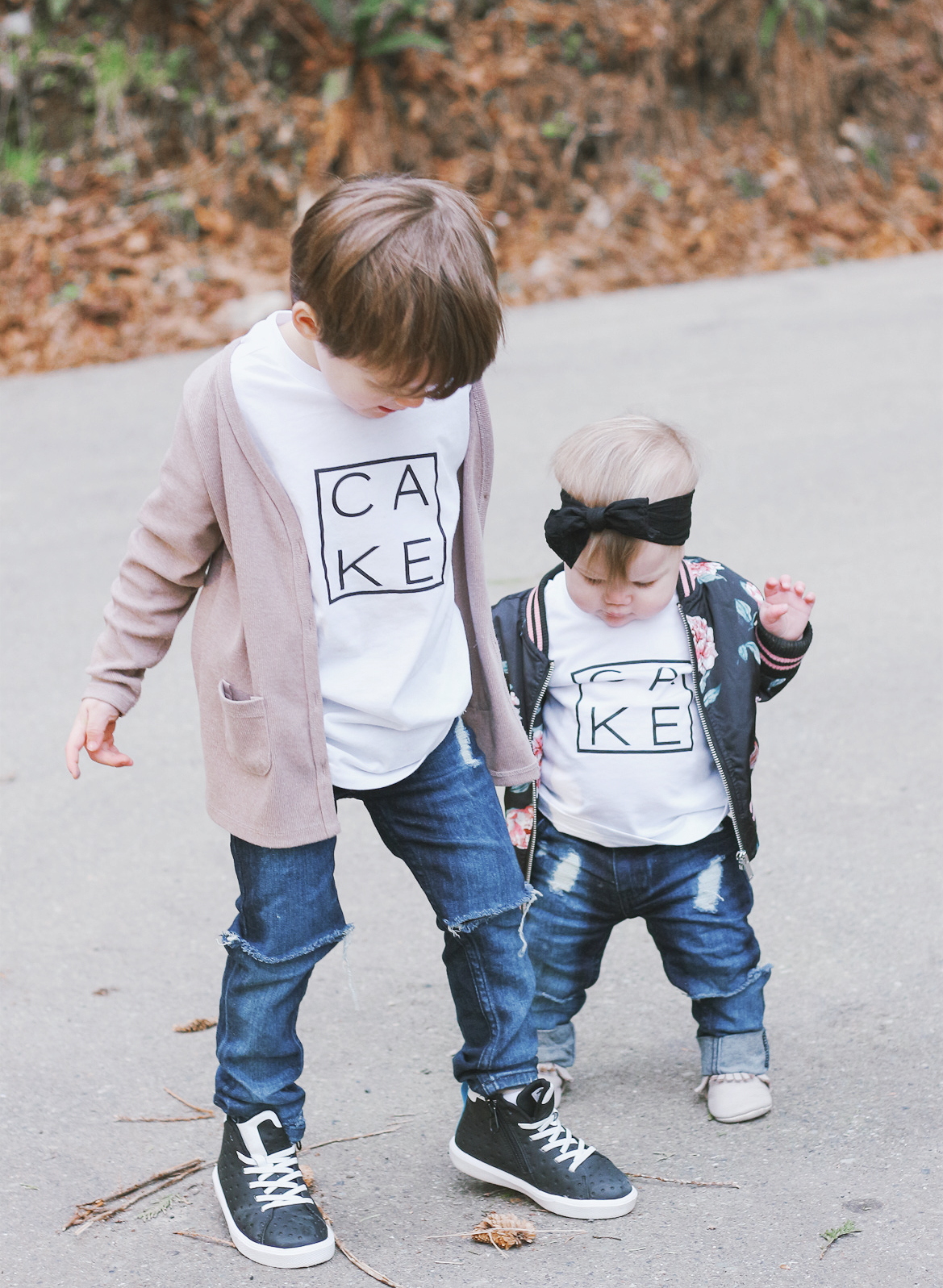
Everything that I love in adult sizes, I love EVEN MORE in baby/child sizes, because it’s tiny and adorable. I am a huge fan of distressed denim because it can be dressed up or down, worn day or night, summer or winter (and obviously worn in my favourite season: fall). Distressed denim also adds some texture and visual appeal, and you can’t go wrong with that (mainly because it helps to distract from the inevitable food and milk stains on my shirt caused by my children). When William was little, I hunted for small shops that had gender neutral clothing, and I happened upon TATTRD Threads; I’ve loved the products ever since! William lives in his TATTRD jeans (tho he still comments on my ripped jeans in an accusatory fashion — what the heck?!) and Isla got her first ever pair of TATTRD denim from the brand-new line!
The owner/designer/distresser extraordinaire (also mom, photographer, wife, generally cool person with relatable and hilarious Instagram stories) behind TATTRD Threads, Sasha, announced earlier this year that she was designing her own line of TATTRD denim.
The new line was released in November, and it’s AMAZING. I asked Sasha if I could interview her about her line — the old, the new, and everything in between — and she graciously accepted. So, here are all the burning questions I had for Sasha:
When did you decide that you wanted your own denim line?
So, from the beginning, when I first started TATTRD Threads — in 2015 — I thought, ‘How cool would it be to have my own denim line?” But it wasn’t until… I was sitting in bed one night nursing Presley — she was two weeks old — and I was like, “I wanna have my own denim line.” And it was the next day that I started looking into it, because living here, where we live now with my parents, I said, “This is the time to do it,” because we don’t have a mortgage we’re worrying about. I don’t need to worry about what it’s going to do for my family financially if I do this and it fails, so, I figured now is the time to do it. When I first was doing it, I was up from 1-5 am with a nursing two-week old talking to the factories, because they don’t wake up our time – you have to wake up their time.
When you first started, why did you decide to use the Osh Kosh denim?
Lincoln was almost 2, and we were living in the States at the time. There are some really great distressed denim shops in the States, and I had ordered a pair [for Lincoln]; Lincoln is really big, and I could just never get stuff I bought to fit him. I wanted to try distressing my own denim. So I looked online, kinda figured out how to do it, and there was an Osh Kosh outlet store five minutes from my house, so I went [there]. It was simply out of convenience, because it was right there; I grabbed a pair of their skinny jeans and distressed it, and the material was perfect to distress with.
I know that ethical shopping is important to you, and ethical shopping is important to a lot of your consumers; people often automatically associate outsourcing with being unethical. Can you explain a bit about your process in choosing an ethical denim factory?
I started reaching out to factories myself, and I got a bunch of samples coming [in]. My friends Annie and David… work with factories in China, but I’ve always heard about the shoe companies they worked with, so I didn’t think they did denim. I reached out to Annie, and I said, “Do you have any advice for me on dealing with factories in China?” and she said, “Why don’t we send you a sample, because we work with denim factories, as well.” They are basically the middle man between China and small businesses, so they are my contact. David is half-Chinese, he speaks Chinese, [and] he travels to China multiple times a year. They find you a factory, they work with the factory, they go over to the factory in China; they are your quality control people. They do all the communicating, which is awesome, because what I was saying to the factory doesn’t always translate for them. Like, when I say, “I want to be able to have material that can hold up to the distressing process and exposed threading; [the threading] has to be strong,” they don’t know what that means, whereas I can make a video that I can show David, and then he can translate it knowing what I mean.
I think that manufacturing China has a bad reputation, but I knew that it was a good factory [because Annie and David work with that factory]. I could be confident that there weren’t children making my children’s denim and that people are paid what they’re supposed to be paid and all that. It was really reassuring, because I know that Annie and David would never work with an unethical factory; they just wouldn’t do that. So, it’s been so worth it to have David as my go-to person.
I think it’s kind of interesting that people consider outsourcing unethical, because it all comes down to regulation. Globalization is a huge part of businesses; we still need to ensure people are getting jobs on the other side of the world, and often times, it’s not really feasible to do things in Canada: it costs too much, it doesn’t necessarily turn out as well — it’s just not a realistic thing to do.
Yeah, do you wanna pay $100 for a pair of denim if the material still most likely came from overseas, but that was manufactured locally? And the reality is, China is the place to go for denim. If you look at a lot of denim, it is made in China, because they know what they’re doing. The factory that I work with has been making denim for 16 years. I initially reached out to a manufacturer here in Vancouver to see what the cost is, but they don’t really know what to do. Plus, China is way more regulated than you would think; I’ve noticed that some big box stores have stopped working with China, and they’ve moved to other places like Bangladesh, and I wonder why — because China recently started being very regulated with their working conditions, with their minimum wage — they’re like us: different provinces in China have different minimum wages. They are really on it now, and a lot of big box stores have stopped manufacturing in China, which I think is interesting.
That’s one of the things I’ve noticed, as well; Bangladesh and Singapore are both places that have progressively been pushed into commercialization and providing factories for outsourcing companies, which is pretty telling, considering the social and economic issues that are in both of those countries. Big companies are basically taking advantage of people who need jobs.
Yes! When I first started using Osh Kosh, they were not made in Bangladesh. Now they’re made in Bangladesh.
How many denim samples did you look at before deciding on the material you chose for your new line?
I had samples brought it from six different factories and also the factory that Annie and David are connected to, and theirs was the best one, so I went with their factory.
How did you decide on the jean-etic make-up of your denim?
Knowing more about denim [was important]. When I used to have the old Vancouver skinnies with the jegging material, they were super, super flimsy, so you could never do the exposed threading on them because the material was too thin and it would rip away. When I started researching it, I was like, “What is that material? What is the material of the other Osh Kosh denim that I used?” [The other denim] was pretty stiff, and I basically wanted to marry those two denims. [I wanted] a denim that is soft and stretchy but can also be distressed; I wanted the best of both worlds. I ended up settling on this fabric, which is 97.5% cotton and 2.5% spandex; they’re soft and stretchy, but you can feel the exposed threading isn’t going to tear — it’s still a structured denim with an adjustable waist.
When it comes to your manufactured denim, do other companies have access to the fabric? Does the company make the same material for other companies?
This is only my denim: the sizing, the fit, the material — this was all designed by me in collaboration with the factory and David.
You do all your own distressing. Most denim companies outsource their distressing, too. Why did you decide to continue distressing the denim by hand?
A couple different reasons: the first is that I love doing it. The second is that it still keeps that local, handmade feel — it’s not handmade, but my hands still touch every piece of denim; every piece is made unique by me. Another big one is all about finances, really: if I’m having [the factory in] China distress, then I need to pick a style for each wash. So I would do the black wash in maybe the Vancouver skinny distressed style, and I would do the dark blue wash in the Lincoln style. But then, if someone’s on the site and they love the wash of the black but they love the distressing of the light blue, they’re not going to buy them. So, by doing this, I’m still able to offer four different distressed styles in three different washes, and I’m still able to offer that handmade aspect to people. I’m the only denim company that has my own line that is hand-distressed. If, for whatever reason, it blows up, I honestly may have it distressed overseas, but as long as I can still do it myself, I’ll do it myself.
Did you get to design the tags yourself? How much of a process was that, just deciding on the minimalism?
I’ll give a shout-out to Hot Soup Group; they are the ones that have done my branding from day one. They designed my logo, they designed my website, they designed my rack cards. Every single piece of branding that you see associated with my brand was done by them. I am lucky that my brother-in-law owns Hot Soup; it’s a digital media marketing firm that specializes in branding. I reached out to him when I started TATTRD Threads, and I’ve worked with them ever since; they do everything!
When I first started out, I had “Tattered Threads” — T-A-T-T-E-R-E-D, so, the actual spelling of it, and Hussein, who’s my brother-in-law [and the owner of Hot Soup Group], said, “How attached are you to that exact name?” He was the one who was brilliant in making it T-A-T-T-R-D… so that the word itself is tattered because it’s missing the E’s, because, by definition, tattered means missing pieces, torn. By taking out the E’s, the word TATTRD is also tattered; it’s very on-brand.
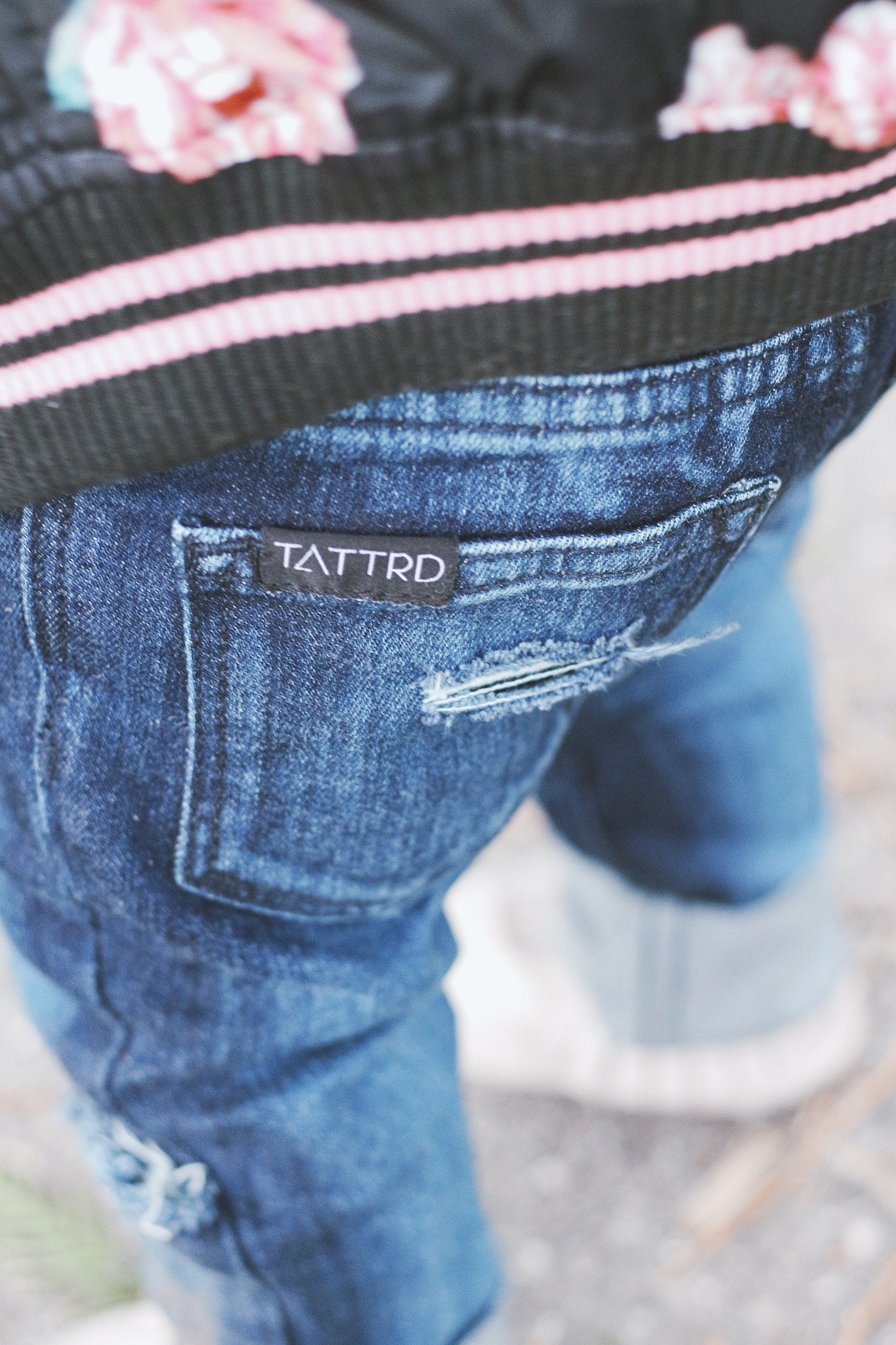
[The new tags on the back pocket] have the same lettering and the same logo [as before], but it was still [a process] figuring out how big we want it. It needs to look good on the 3-month pair and the 6T pair because it’s all the same size tag. And then there are the little things, like how you want it to look on the pocket. Hot Soup designed the inner tags; I really wanted to focus on the ‘Hand Distressed in Vancouver,’ and then on the back, I wanted to make sure people knew that [the jeans are] ethically made in China.
Was it Hot Soup Group that decided not to put “TATTRD Threads” on the inside tag? It’s super minimalist; I really like it!
That was me: I figured that we don’t need to see the “TATTRD” again. That was me not wanting the logo everywhere. My approach is minimalist because my denim is busy enough as it is, so I don’t need to have branding that’s all over the place, and I don’t need a website that’s hard to navigate. I wanted something that’s clean and simple.
Why did you decide to absorb some of the cost of shipping with the introduction of the new denim line?
Because people hate paying for shipping! I’m trying to reduce the cost for people, but it’s hard because denim is bulky. I do letter-mail shipping by vacuum-[sealing] the denim, but if someone orders two pairs, I have to send them separately because two pairs of denim won’t fit in the same letter-mail container, so I have to charge $4 per pair of denim instead of $4 overall.
That makes sense! What’s your favourite wash from the new line?
I like all of them, honestly; I can’t pick a favourite. All of them! I truly mean that: I love them all.
What’s your favourite style?
I love all the different styles, as well. There’s something about the Lincoln skinnies with that diagonal, distressed look that I love. I also love the minimalist approach to the Presley skinnies. I love the Vancouver skinnies because they are still minimalist but have a little bit more to them. And then, the Britton skinnies are just a nice staple piece.
I will say that I like the Lincoln skinnies on Britton and Lincoln more because they’re standing, walking; you can see it more. Whereas with Presley, I like the exposed knees on her because she’s sitting and you can’t really see the upper thigh stuff. I really do love them all — I wouldn’t have them if I didn’t love them.
What is your favourite style to make?
Artistically, my favourite one to make is the Lincoln skinnies. If I’m super busy, I love when it’s all Presley skinnies because I can bang them out pretty quickly.
What were some things throughout the process that surprised you, or maybe that you didn’t expect?
The things you don’t think about: What colour do you want your stitching to be? What pantone colour do you want, specifically? What they would do is send me a swatch and sew different stitching colours on. I started looking at everybody’s denim as they walked by. I didn’t want it to be too bold, I didn’t want it to be too yellow; I wanted it to be a pale, neutral yellow to complement [the denim].
Do you plan on making and designing more types of clothing fabrics — like for your tees, for example — to expand TATTRD Threads?
I use Jericho [for the t-shirts] right now, which is a Canadian brand, so it keeps it sort of local. I like the idea of continuing to use the Jericho shirts, because it works and because they can be screen-printed on well.
You’ve mentioned that you don’t want to do adult denim. Have you thought about doing older kids’ sizes in distressed denim?
Yes, and I’ll address the adult thing: adult denim is a super saturated market. You can buy a $50 pair of amazing distressed jeans from Vici Dolls in the States; I know that because I own them. I can’t compete with that! They’re ordering thousands and thousands of pairs in each size, so how do you compete with that? Also women — we are hard to please — when you buy a pair of jeans, especially ordering online with no place to try it on, [it’s hard]. I don’t want to deal with exchanges from women not loving the fit; it’s too much. I couldn’t do returns, and I don’t want people having a pair of jeans that they spent $100 on that they won’t wear and that they don’t love.
But, I’m sure as Lincoln gets older — I want him to still be able to wear my stuff — I’ll start wanting to manufacture bigger sizes, for sure.
Perfect, because William is a size smaller than Lincoln! Do you think, realistically, you’ll make distressed denim for teens? I don’t know much about the teen distressed denim market.
I think that parents of 13-year-olds weren’t — and aren’t — small shoppers. I wonder if as people like you and me — as our kids get older — if we’re going to continue to look for small shops to buy our kids’ clothes from. If the need grew because there were people that wanted small shop stuff, then I would definitely think about it, but for now, people with teens just aren’t interested in small shops the way I am.
Do you think people have misconceptions about why you’ve opted to start your own denim line?
People think it’s so much cheaper to manufacture overseas, but it’s not cheaper. It wasn’t about making it cheaper for me; this is about developing a brand, and it’s about fulfilling this dream that I’ve had from the beginning of having my own denim line. This isn’t about making more money for me. This is about developing a brand and really making it my own.
What does the process of distressing and its aftercare look like?
The denim gets distressed, then washed in cold water and dried with no heat.
What’s the best way to take care of TATTRD Threads denim?
People ask why we recommend hand-washing the denim, and that’s to keep the integrity of the distressed material, because the more you wash and dry it, the more the appearance of it will change slightly. Denim breaks down over time the more you wash it. Honestly, I recommend spot cleaning and putting the denim in the freezer if they’re smelly – that’s what people with old-school denim do: they don’t wash them, they put them in the freezer to get the smell out of them because it keeps the denim looking fresh.
What’s something that your customers might be surprised to know?
I almost didn’t do the dark wash, because the dark wash has never sold well for me on my Osh Kosh denim, so I was like, “What can we do with a dark wash to make it a bit different than your average dark wash?” and it’s the black stitching that we went with. Red is really common [for stitching] in dark washes, but I think [the black stitching] makes it stand out a bit more and makes for a nice, clean look.
How are you finding juggling everything that comes with having your own line (like 3,000 pairs of denim in your house) with your photography business?
The week that all the denim came in was a fucking shit-show. It’s the struggle of trying to manage two businesses; my minis needed to happen, as well, because people want to do Christmas minis, but it just so happened that it coincided with the launch of this [new line]. It just meant that my mini session clients got their minis very quickly because I hustled to get them done. I had 29 minis on November 17th and 18th, and my goal was to have everything finished by November 22nd. My denim arrived at 3pm on Friday the 23rd, and then I had a double market weekend on November 24th and 25th, and I’ve had a market every weekend since.
How is juggling all of this with parenting?
My cleaner, Kris — who’s also very involved with our family — used to run a daycare, and she helps out. It’s really challenging; Paw Patrol babysits Britton a lot. And it’s weird — it’s this weird guilt you feel as a small business owner when you have pending orders and if you have even 10 minutes of free time, you’re like, “well, I need to do orders!” I felt like I couldn’t just sit and do nothing because people are waiting on their orders and I don’t want to disappoint people. That’s been the biggest struggle; even though I’ve been in business for three years, it’s the biggest struggle that I’m finding right now: that guilt of wanting to get everything done. And, mentally, not having my own designated work space has done very bad things for my anxiety; I see my shit everywhere, and I feel like stuff goes missing — I can’t find my scissors because Lincoln has taken them, and I use very specific scissors because they have to be sharp enough.
It’s also hard for your spouse to get used to you working at home. I might be sitting there on the couch, but I’m editing a session and I’m not available necessarily — obviously I’m available if something happens, but if Blake is home and I’m working, I’m working. If Britton needs to get put to bed, Blake needs to put him to bed. If I’m in the middle of editing a session and I’m on a roll, I want to keep going because I’m feeling very creatively motivated. Same with distressing: if I’m in the middle of distressing, I literally cannot stop. If I make myself a pile that needs to get distressed, I cannot stop until it’s done; I have to get it done. So, having my own space downstairs is going to be really nice, and I’m going to try to set hours for myself.
Is there anything else that you wanted to share or talk about in terms of TATTRD Threads?
Yes; it’s something that’s so weird to talk about. My mom always talks about trying to find the silver lining in things, and if I hadn’t ever miscarried, then I wouldn’t have started this, because it was during my miscarriages when I was in Portland that I started doing it. I sometimes think about, wow, the path that life takes you. If that had never happened, I would’ve been busy with a newborn, or I would’ve been pregnant. Would I have done this? And I don’t know if I would have.
I want to thank Sasha for taking the time to answer these questions! I had a ton of fun, and I learned a lot about her business and what it takes to run a small business in general. If you have any questions for Sasha, find her at @tattrdthreads and @sashablaneyphotography on Instagram.
At TATTRD Threads, you can find three different washes of denim in four different distressed styles: the Vancouver Skinnies, the Lincoln Skinnies, the Britton Skinnies, and the Presley Skinnies. Distressed denim not your thing? Check out the Basic Skinnies or the TATTRD tees; they’re staple pieces that any kid (and parent) will love. Let me know all of your favourite things about TATTRD Threads in the comments!